

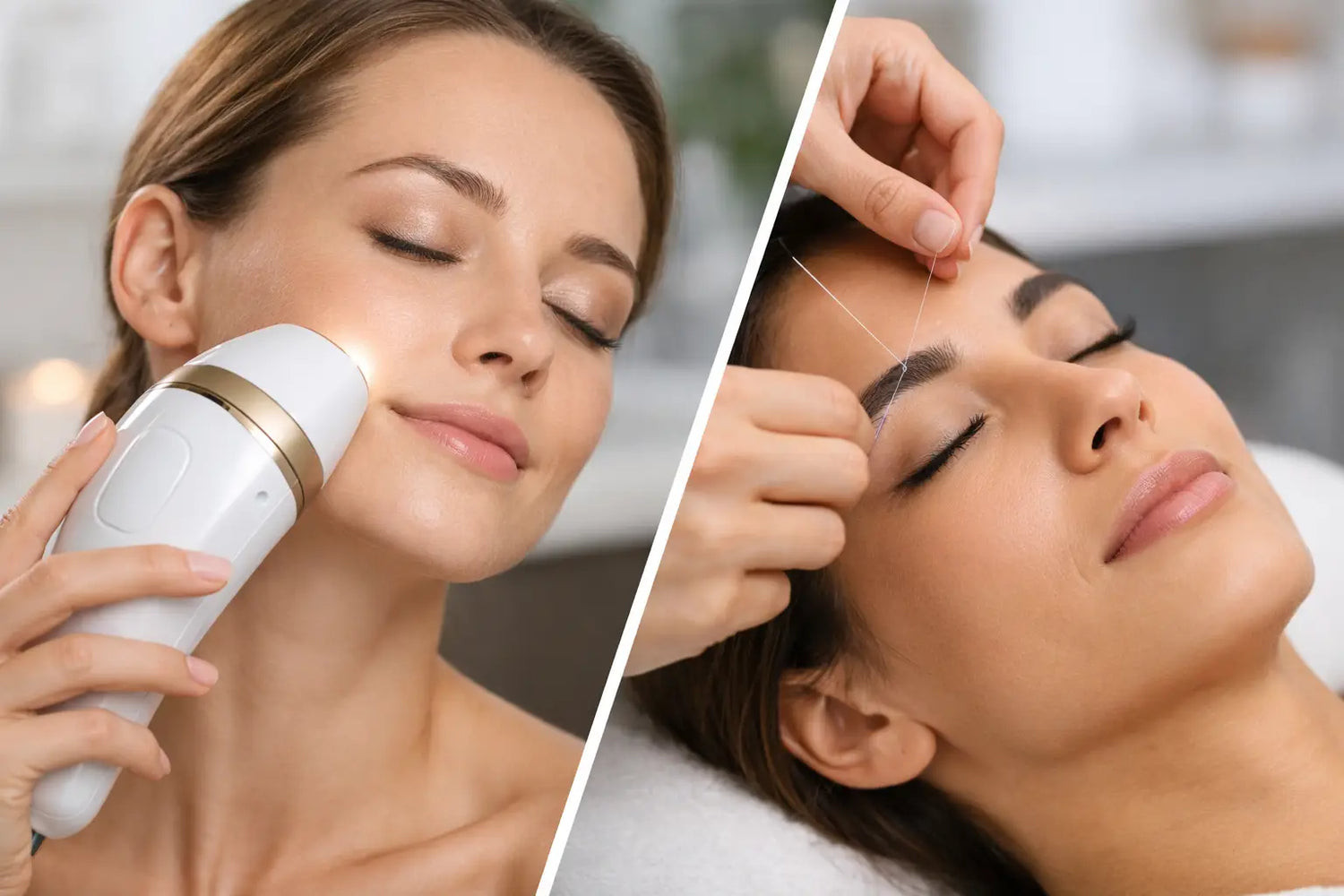
Upper lip fuzz has a way of showing up right when you notice everything else about your skin too. If you’re stuck between home IPL vs threading face treatments, the real question is simple - do you want quick cleanup every few weeks, or a routine that can reduce regrowth over time?
Both methods can work. But they work very differently, and that difference matters when you’re dealing with delicate facial skin, busy schedules, and the cost of repeating the same grooming step again and again.
Home IPL vs threading face: the biggest difference
Threading removes hair from the root using twisted thread. It’s precise, fast, and especially common for shaping brows or cleaning up small facial areas like the upper lip, chin, and sides of the face. The result is immediate smoothness, but the hair eventually grows back because the follicle is still active.
Home IPL uses pulses of light to target the pigment in the hair follicle. Instead of removing hair in the moment, it helps disrupt future growth. That’s why it takes consistency at first, but the payoff is longer-term reduction rather than constant upkeep.
If your goal is instant hair removal for a specific event, threading has the edge. If your goal is less facial hair over time and fewer appointments, home IPL usually makes more sense.
What threading does well
Threading has stayed popular for a reason. It’s simple, doesn’t use chemicals, and gives you a very clean finish right away. For brows, it can be hard to beat. The precision is great, and for small facial touch-ups it feels familiar and low-commitment.
There’s also no waiting period for the hair to shed after treatment. You leave with the hair gone. For someone who wants visible results the same day, that convenience matters.
Another advantage is that threading works on a wide range of hair colors because it doesn’t depend on pigment. Blonde, gray, red, and fine hairs that may not respond well to IPL can still be physically removed by threading.
But threading has trade-offs. It can sting, especially on sensitive areas like the upper lip. It may also trigger redness, irritation, or little bumps right after treatment. For some people, repeated pulling can leave skin feeling reactive, particularly if they’re already using exfoliants, retinoids, or acne treatments.
Where threading starts to feel expensive
One threading appointment might seem cheap. The pattern is what adds up.
Facial hair grows back. That means repeated visits, repeated discomfort, and repeated planning around your schedule. If you thread your upper lip, chin, or sideburn area regularly, the yearly cost can become much bigger than it first looks. The time cost adds up too.
That’s the part many people get tired of - not the single appointment, but the endless cycle.
How home IPL works on the face
Home IPL is built for people who are done with the repeat-every-few-weeks routine. It sends light energy into the follicle to slow down regrowth. Over a series of treatments, many users notice hair coming back finer, more slowly, and in some areas not returning the same way at all.
This is why IPL feels different from threading from the very beginning. It’s not a one-session fix. It’s a plan. You commit to a treatment schedule upfront so you can spend less time managing facial hair later.
For beauty-conscious women who want smoother skin without the constant salon loop, that trade can feel worth it very quickly.
Home IPL vs threading face for pain and comfort
Pain is personal, but these methods feel different enough that most people have a clear preference.
Threading creates a sharp pulling sensation. Some people tolerate it fine. Others dread it every time, especially around the upper lip where the skin is thinner and more sensitive. Even when the appointment is short, the discomfort is hard to ignore.
Home IPL is often described as a warm snap or light flick against the skin. Modern at-home devices are designed to be much more comfortable than older light-based treatments, and many people find the sensation easier to deal with than repeated hair pulling.
That said, comfort also depends on your skin tone, hair color, settings, and how carefully you follow directions. It should feel manageable, not aggressive. If you’re choosing between a method that hurts every few weeks and one that aims to reduce the need for hair removal over time, IPL usually wins on long-term comfort.
Which is better for sensitive facial skin?
This is where it depends.
Threading can be a problem for skin that gets red easily, breaks out after friction, or reacts badly to repeated tugging. If you’ve ever had post-threading bumps, irritation, or sensitivity around the mouth and chin, you already know the downside.
IPL can be gentler in a different way because it doesn’t yank hairs out one by one. But it still requires caution. Facial skin is delicate, and not every area should be treated casually. You need to use a device exactly as directed and only on suitable areas and skin tones.
One more reality check: IPL works best when there’s enough contrast between skin tone and hair color for the light to target the follicle effectively. Threading doesn’t have that limitation. So if your facial hair is very light, threading may still be the more practical choice.
Results: immediate vs progressive
Threading gives immediate smoothness. That’s its strongest selling point.
IPL gives progressive change. You won’t get the same instant before-and-after right after one session, because the goal isn’t just removal - it’s reduction. The payoff comes as regrowth slows down and your routine gets lighter.
If you only care about today, threading is the obvious winner. If you care about the next six months, home IPL becomes much more attractive.
That’s why this comparison often comes down to mindset. Threading is maintenance. IPL is strategy.
Cost over time
For occasional brow cleanup, threading is affordable enough. But for regular upper lip, chin, or side-of-face hair removal, the economics shift.
A home IPL device is a higher upfront purchase, but it can become the lower-cost option over time because you’re not paying per visit. That’s one reason at-home devices have become so appealing - they offer a salon-inspired approach without locking you into salon pricing.
If you’ve been spending money every month just to stay on top of facial hair, home IPL can feel less like a splurge and more like an exit from the cycle.
When threading makes more sense
Threading is still the better fit in some cases. It’s ideal for eyebrow shaping, quick event prep, and hair colors that IPL may not target well. It also suits people who don’t want to commit to a treatment schedule and just want occasional cleanup.
There’s also the comfort factor of familiarity. Some people simply trust what they already know. If threading has always worked for you and you only treat small areas once in a while, there may be no urgent reason to switch.
When home IPL is the better move
If you’re tired of repetitive appointments, annoyed by fast regrowth, or looking for a more affordable long-term alternative, home IPL is usually the smarter beauty investment. It fits especially well for women who want smooth skin with less ongoing effort.
That’s the real appeal. You do your treatments at home, on your time, without building your schedule around salon visits. For many users, that convenience matters just as much as the hair reduction itself.
A device like NOHA is designed around exactly that promise - easier upkeep, more comfort, and a path away from constant facial hair maintenance.
So which one wins?
In the home IPL vs threading face debate, threading wins for precision and instant results. Home IPL wins for long-term convenience, lower repeat costs, and the freedom of not having to start over every few weeks.
If your main concern is shaping brows or removing very light facial hair, threading still has a place. But if you want a routine that feels smarter, more cost-effective, and less dependent on repeat appointments, home IPL is hard to ignore.
The best choice is the one that matches how you actually want to live with facial hair - as a constant task, or as something you’re actively working to reduce for good.


Leave a comment
This site is protected by hCaptcha and the hCaptcha Privacy Policy and Terms of Service apply.