

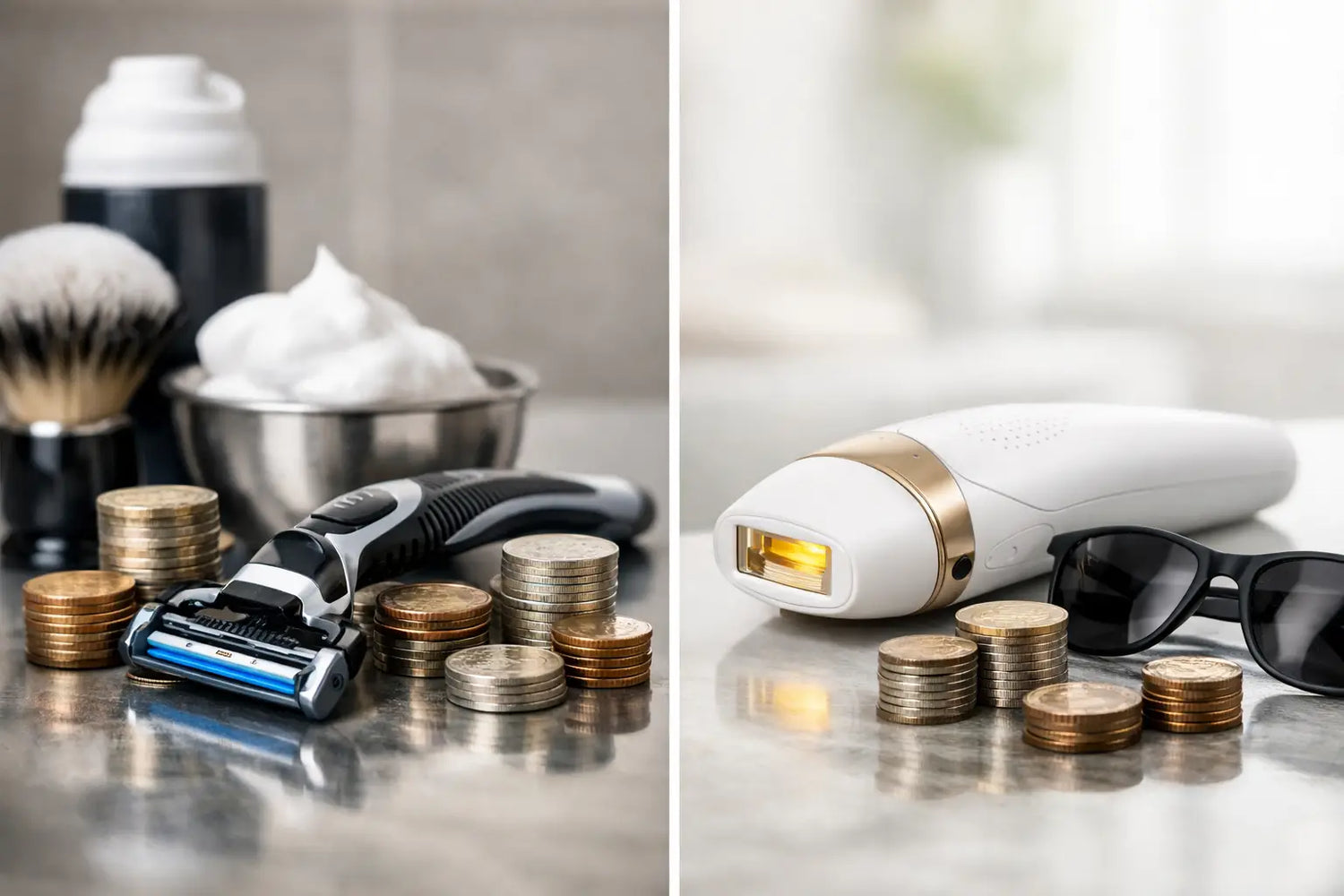
If you have ever stood in the razor aisle thinking, it’s only a few dollars, the real shaving vs IPL costs story can be easy to miss. Shaving feels cheap because the cost shows up in small, repeat purchases. IPL feels bigger upfront because you pay more at once. But over time, those small shaving expenses stack up fast - and they keep going.
That’s the real difference. One method keeps charging you for smooth skin. The other is built to reduce the cycle.
Shaving vs IPL costs over time
Shaving usually wins the first-payment comparison. A razor, shaving cream, and maybe a moisturizer do not look expensive in a single checkout. The problem is that shaving is never a one-time purchase. You replace razors, buy more cream, deal with dull blades, and often add extra products for bumps, ingrowns, or irritation.
IPL works the opposite way. You make a larger upfront investment in a device, then use it at home over a longer period. Instead of paying every week or every month, you are paying for repeated use from one device. That changes the math.
For someone who shaves regularly, the cost is not just the razor itself. It’s the refill blades, the gel, the aftercare, and the ongoing time spent doing it. If you shave multiple areas like legs, underarms, bikini line, or arms, the routine becomes even more expensive.
Why shaving feels cheaper than it is
Shaving is built around low-friction spending. A pack of blades here, a gel there, a soothing lotion when your skin is irritated. None of it feels dramatic in the moment. That is exactly why it is easy to underestimate.
Let’s say you spend modestly. You buy razors or blade refills several times a year, replace shaving cream regularly, and occasionally buy products for razor burn or ingrown hairs. Over a few years, that adds up to hundreds of dollars. For many people, it reaches well beyond that.
Then there is the maintenance factor. Shaving does not slow hair growth in any meaningful way. It is a short-term fix, so the spending never really pauses. If smooth skin is part of your routine year-round, shaving is a recurring bill disguised as a habit.
That habit also costs time. A few minutes in the shower does not sound like much until you multiply it over months and years. If you are tired of planning outfits, vacations, or last-minute events around whether you shaved, that time cost starts to feel personal too.
What you’re really paying for with IPL
IPL stands for intense pulsed light. At-home IPL devices target the hair at the root with light energy, helping reduce regrowth over time. The appeal is simple: less hair, less often, from home.
From a cost perspective, IPL is less about a single treatment and more about long-term value. You buy the device, follow the treatment schedule, and use it across multiple body areas. Once you have it, you are not buying endless blade refills to keep going.
This is why IPL often makes more financial sense for people who are done with repetitive grooming. Instead of paying forever for temporary results, you are paying upfront for a solution designed to reduce the need for constant maintenance.
A device like the NOHA Device fits into that shift. It is positioned for women who want salon-inspired results without salon pricing, and that matters in a category where convenience and value are just as important as the end result.
A simple cost comparison
The exact numbers depend on your routine, but the pattern is usually consistent.
If someone spends $10 to $25 per month on shaving supplies, that comes out to $120 to $300 per year. Over three years, that becomes $360 to $900. Over five years, it reaches $600 to $1,500.
Now compare that with an at-home IPL device. Even if the upfront price feels higher than a cart of razors, it often falls well below what many people spend on shaving over the long run. And unlike shaving, the goal with IPL is not to stay in a forever cycle of constant buying.
That does not mean IPL is free after purchase. You still invest time into the treatment plan, and results vary by skin tone, hair color, consistency, and the device itself. But the cost curve is different. Shaving keeps climbing. IPL is front-loaded.
The hidden costs people forget
The shaving vs IPL costs conversation is not just about what shows up on your receipt. It is also about what your routine quietly demands from you.
Skin irritation is one of the biggest hidden costs of shaving. Razor bumps, dryness, itchiness, and ingrown hairs often lead to extra spending on exfoliants, soothing creams, body serums, or replacement blades because the old ones got dull too quickly. If you have sensitive skin, the cost can climb even faster.
There is also the cost of urgency. Shaving is often done because you need smooth skin now - before the beach, a night out, a date, or a trip. That last-minute pressure can make the routine feel annoying and never-ending. IPL is not instant, but it is built to reduce that dependence over time.
For many women, that freedom is worth more than the price difference on paper.
When shaving may still make sense
IPL is not automatically the right choice for every person in every situation. If you shave occasionally, treat only a small area, or simply do not mind the upkeep, shaving may remain the cheaper short-term option.
It can also make sense if you are not ready for the upfront purchase of an IPL device. Budget matters. A lower immediate spend can feel more realistic, even if it costs more later.
There are also suitability factors. IPL does not work the same way for every skin tone and hair color combination, and not every user will see the same timeline of results. That is why realistic expectations matter. The value of IPL gets stronger when you are a good candidate and willing to stay consistent.
When IPL usually wins
IPL tends to win when you shave often, treat multiple body areas, and want a lower-maintenance routine. If you are spending money every month just to keep up with visible regrowth, the long-term math starts leaning away from shaving pretty quickly.
It also wins for people who are tired of the cycle itself. The constant buying, the daily or weekly upkeep, the stubble, the irritation, the mental checklist before wearing certain clothes - all of that has a cost. Not always a dramatic one, but a real one.
That is where at-home IPL feels less like a beauty splurge and more like a smart upgrade. You are not just buying a device. You are buying fewer repeat purchases, fewer rushed touch-ups, and a smoother routine.
Cost is only part of the decision
Money matters, but it is not the whole picture. The better question is not just which option costs less. It is which option gives you better value for the way you actually live.
If you want the lowest upfront spend today, shaving probably looks better. If you want fewer repeat purchases and a routine that does not keep demanding your time, IPL usually has the stronger case.
That is especially true for women who are beauty-conscious but practical. You want smooth skin, but you also want convenience. You want results, but you do not want to keep paying for the same temporary fix over and over.
So, which one saves more?
In most long-term scenarios, IPL saves more than shaving. The savings are not always obvious in week one, but they become much clearer over the months and years. Shaving spreads the expense out. IPL concentrates it upfront. That difference is what makes shaving feel affordable even when it ends up costing more over time.
If your goal is to spend the least today, shaving is the easy pick. If your goal is to spend less over the life of your routine, IPL is usually the smarter one.
Smooth skin should not feel like a subscription you never signed up for. Sometimes the better beauty buy is the one that helps you stop buying the same thing again and again.


Leave a comment
This site is protected by hCaptcha and the hCaptcha Privacy Policy and Terms of Service apply.