

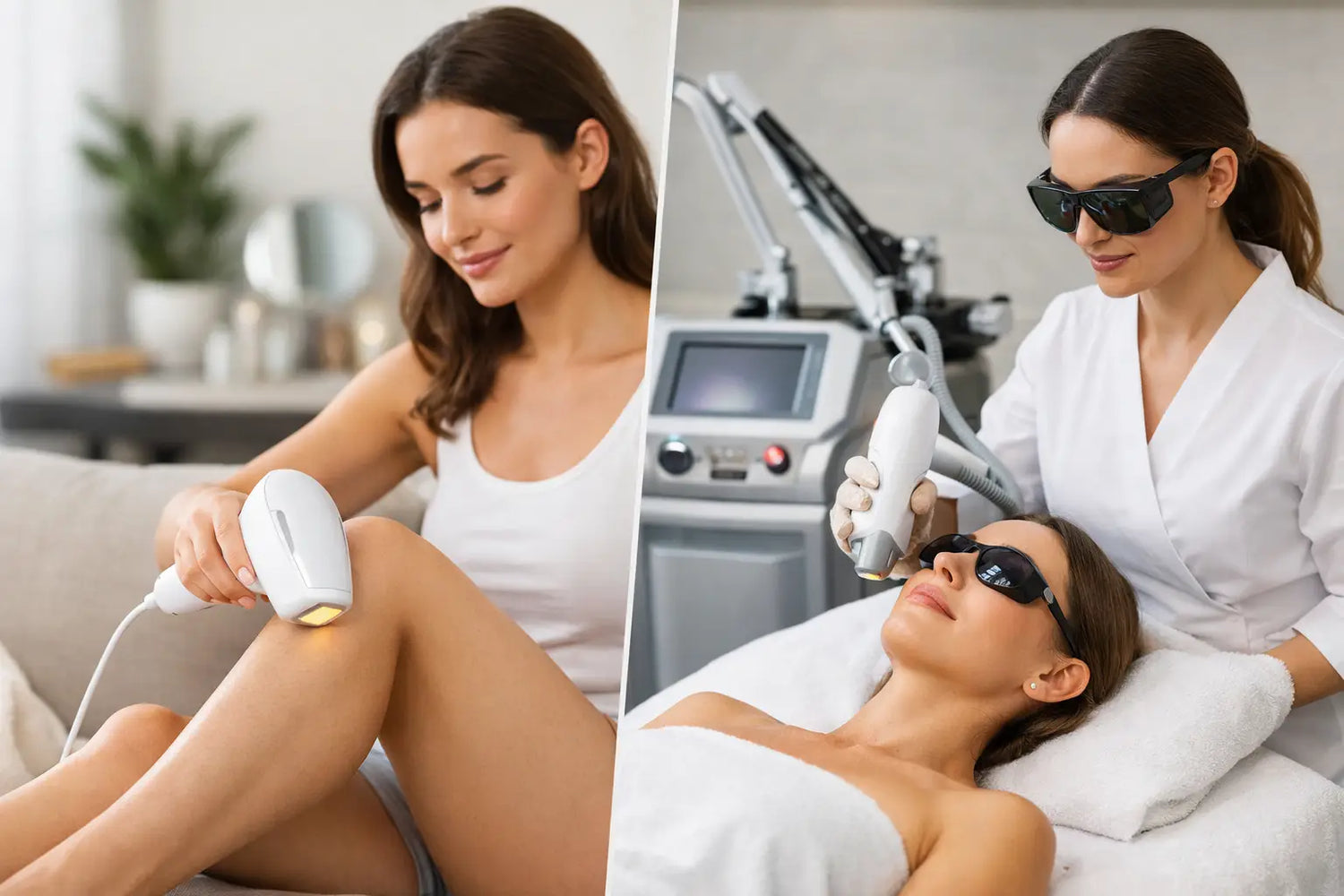
You can keep booking appointments, rearranging your week, and paying again every few weeks - or you can put hair removal on your own schedule. That is why the question of home laser versus clinic sessions matters so much. For most people, this is not just about technology. It is about time, comfort, consistency, and whether smooth skin can actually fit real life.
Both options aim to reduce hair growth over time. Both use light-based technology to target the pigment in the hair follicle. But the experience, price, and day-to-day commitment feel very different. If you are trying to choose the smarter option, the best answer depends on your budget, your pain tolerance, your routine, and how much control you want over the process.
Home laser versus clinic sessions: what is the real difference?
At the highest level, clinic treatments usually use stronger professional machines operated by trained staff in a medical spa or dermatology setting. At-home devices are designed for personal use, with built-in safety features and a simpler treatment process.
That difference sounds obvious, but it changes everything. Clinic sessions often feel more intense, cost more upfront and over time, and require you to show up on someone else’s schedule. Home devices are made to be convenient, more affordable over the long run, and easy to use in private.
For many women, the real comparison is not just power versus convenience. It is whether faster professional intensity is worth the recurring expense and appointment cycle, or whether steady at-home consistency is the better fit.
Cost is where the gap gets hard to ignore
Clinic hair removal can get expensive quickly. Even if a single session sounds manageable, most treatment plans require multiple visits for one area. If you want underarms, bikini, legs, or face treated, the total rises fast. And touch-ups later on can add even more.
At-home devices shift that math. Instead of paying per appointment, you make one purchase and use the device repeatedly across multiple body areas. That is a major reason so many shoppers start looking at home laser versus clinic sessions in the first place. They are tired of temporary fixes that keep charging them.
If your goal is long-term value, home use usually wins. You are not paying for a provider’s overhead, room time, or per-visit treatment. You are investing in a tool you can keep using.
That does not mean clinic treatment is never worth it. If someone wants professional support and is comfortable with the higher cost, clinic sessions can make sense. But for budget-conscious beauty routines, at-home treatment is often the more realistic choice.
Convenience changes whether you will actually stick with it
Hair removal works best when you stay consistent. That sounds simple, but consistency is where many people fall off. Busy workweeks, kids, commuting, travel, and plain old fatigue make it hard to keep every appointment.
Clinic sessions ask you to plan ahead, get there on time, and fit your body-care routine into a fixed schedule. If you miss appointments or space them too far apart, your progress can feel slower and more frustrating.
At-home devices remove that barrier. You can treat when it works for you - before a shower, at night, on weekends, or while catching up on a show. That flexibility is a huge advantage because the easiest routine is usually the one you keep.
For women who want beauty maintenance to feel less like a chore, at-home treatment is simply easier to live with. You are not organizing your month around a session. You are fitting the session into your month.
Pain and comfort depend on the person, but home usually feels easier
One of the biggest worries around any light-based hair removal is discomfort. A lot of people have heard stories about stinging, heat, or sensitivity, especially in clinics.
Professional machines can be more intense, which can also mean more sensation during treatment. Some people tolerate that just fine. Others dread it, especially on more sensitive areas like the bikini line or upper lip.
At-home devices are usually built with comfort in mind. They tend to use lower-intensity settings than professional systems and often include features designed to make treatment feel more manageable. That makes them appealing for first-time users and anyone who wants a more comfortable experience.
This is one of those areas where it really depends. If your top priority is the strongest possible treatment in a supervised setting, clinic care may still appeal to you. If your top priority is a painless or lower-discomfort routine you can handle consistently, home use often feels more approachable.
Results: faster is not always the same as better
This is where the comparison needs honesty. Clinic treatments may produce noticeable reduction faster for some people because the equipment is stronger. That is the main advantage.
But faster does not automatically mean better for everyone. Results depend on skin tone, hair color, hormonal factors, treatment consistency, and the area being treated. Someone who pays for a strong clinic session but misses follow-up appointments may not be better off than someone who uses an at-home device regularly and correctly.
With home devices, progress is usually gradual. You commit to a schedule, stay patient, and let the reduction build over time. For many users, that trade-off is worth it because the process is private, lower-cost, and easier to maintain.
The strongest option on paper is not always the best option in real life. The best option is the one you can afford, tolerate, and use consistently enough to see results.
Home laser versus clinic sessions for different lifestyles
If you love high-touch service, want a provider guiding every step, and do not mind paying a premium, clinic sessions may feel reassuring. Some people genuinely prefer having a professional handle everything.
If you care most about flexibility, privacy, and getting salon-inspired treatment without the salon price, at-home devices make more sense. They are especially appealing for women who are done with shaving every few days and do not want waxing appointments to become a permanent line item in the budget.
Home treatment also fits better for maintenance-minded users. If you like the idea of having your device ready whenever you need it, instead of booking touch-ups through a clinic, the value becomes even clearer.
This is why brands like NOHA resonate with so many shoppers. The promise is simple and powerful: smoother skin, less hassle, and more control without the recurring clinic bill.
Safety matters, whichever route you choose
Professional treatment comes with trained oversight, which can be reassuring. But that does not automatically make at-home treatment unsafe. Quality at-home devices are designed with user safety in mind and made for straightforward use.
The key is following instructions carefully, checking whether your skin tone and hair color are a good fit for the device, and staying consistent with the recommended schedule. You should also avoid treating over irritated skin, active lesions, or areas your device guidance says to skip.
In a clinic, safety depends partly on the skill of the provider and the quality of the consultation. At home, safety depends partly on using the device correctly. Neither option is magic. Both require attention.
So which option is actually better?
If money is no object, your schedule is flexible, and you want professional oversight, clinic sessions can be a strong option. They may deliver quicker reduction for some users, and that matters.
But for most everyday shoppers comparing home laser versus clinic sessions, at-home treatment has the stronger overall value. It is more affordable, easier to keep up with, more private, and usually more comfortable. Those advantages matter because hair removal is not a one-time event. It is a routine, and routines need to be sustainable.
The smartest choice is not always the flashiest one. It is the one that helps you stay consistent long enough to stop thinking about hair removal all the time.
Smooth skin should feel freeing, not expensive or exhausting. If your routine works with your life instead of against it, you are much more likely to keep going and finally see the payoff.


Deja un comentario
Este sitio está protegido por hCaptcha y se aplican la Política de privacidad de hCaptcha y los Términos del servicio.