

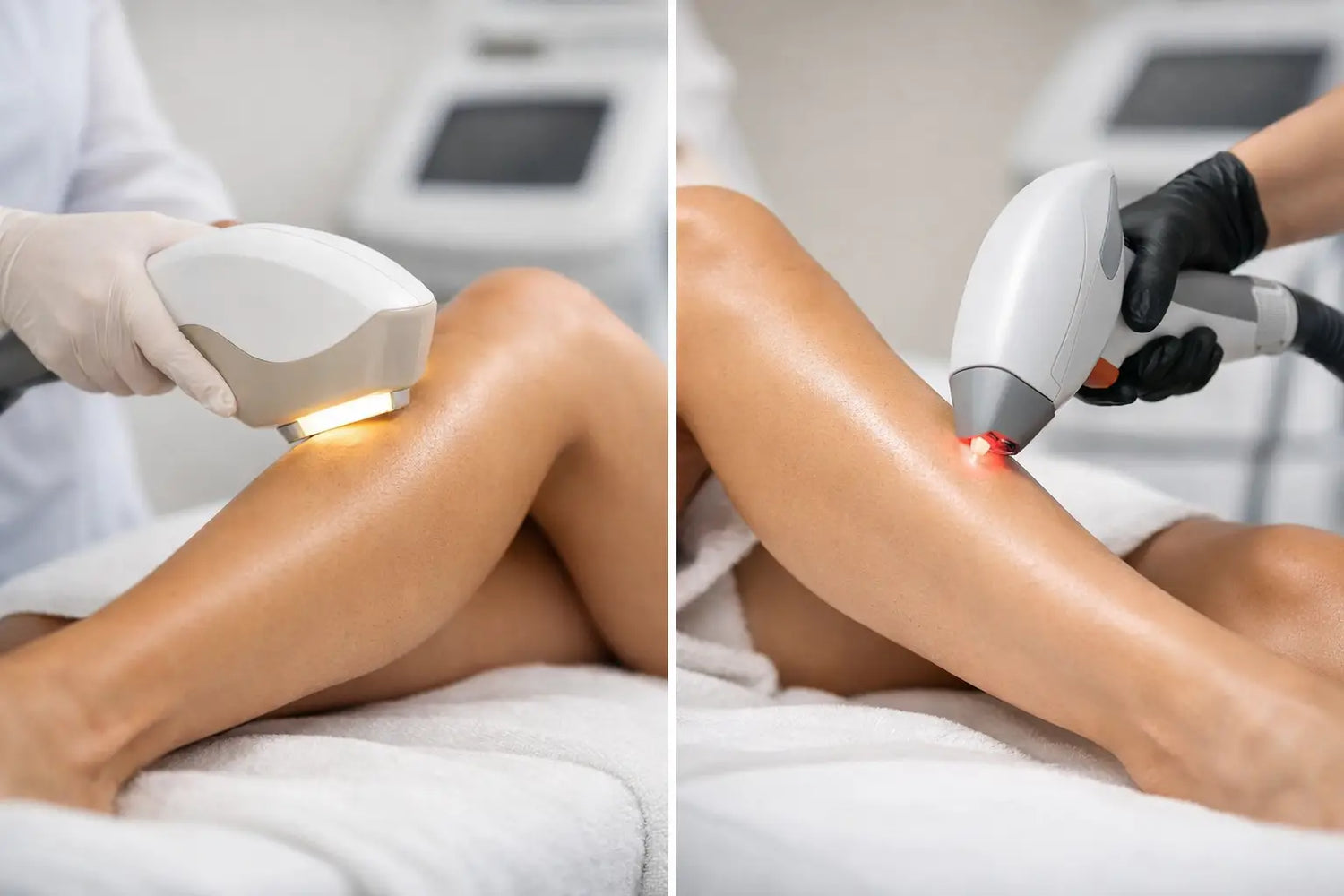
If you are tired of shaving every other day or booking wax appointments you barely have time for, the real question is not whether light-based hair removal works. It is which option fits your life better. When comparing IPL vs laser hair removal, most people are really asking about three things: how well it works, how much it costs, and whether it is worth the hassle.
For most beauty routines, convenience matters just as much as results. Smooth skin sounds great, but not if it means expensive appointments, painful sessions, or a schedule that feels impossible to keep. That is why this comparison matters.
IPL vs laser hair removal: the core difference
Both IPL and laser hair removal use light to target pigment in the hair follicle. The goal is similar - slow regrowth and reduce hair over time. But they do not work in exactly the same way.
Laser hair removal uses a single, focused wavelength of light. That makes it more precise, which is why clinics often use it for targeted treatment plans. IPL, which stands for intense pulsed light, uses broad-spectrum light. It spreads light across a range of wavelengths, which makes it less focused than a laser but still highly effective for many people when used consistently.
That technical difference matters, but not always in the way people assume. Clinic laser is often positioned as the premium option because it is performed by a professional and uses specialized equipment. IPL is usually the more accessible option because it brings salon-inspired technology into your home at a much lower cost.
Which one gives better results?
This is where expectations need to be realistic. Neither option usually means you do a few sessions and never think about body hair again. Hair growth cycles are stubborn, and results depend on your skin tone, hair color, consistency, and the area you are treating.
Laser can produce strong results, especially when done in a clinic with the right settings for your skin and hair type. Because the light is concentrated, it may work faster for some people, particularly on coarse, dark hair. That said, faster does not always mean easier.
IPL can also deliver long-term hair reduction, especially for people who stick to a treatment schedule. At-home IPL devices are popular for a reason - they make it easier to keep up with regular sessions. And consistency is a huge part of getting visible results. A treatment only works if you actually do it.
For many women, the better option is not the one that sounds most advanced. It is the one they can realistically use often enough to see smoother skin over time.
Pain, comfort, and what sessions feel like
Let us be honest. If a treatment hurts too much, most people will not keep doing it.
In-clinic laser hair removal can feel uncomfortable, especially on sensitive areas. People often describe it as a snapping or hot pinching feeling. Some machines include cooling features, and pain levels vary by body area and personal tolerance, but laser is not usually chosen because it feels relaxing.
IPL is often seen as the gentler option, especially with modern at-home devices designed around comfort. Many users describe it as a warm flick or light snap rather than intense pain. That comfort factor matters more than people think because it can make regular use feel manageable instead of stressful.
If your goal is to replace shaving or waxing with something that feels less harsh and easier to maintain, IPL has a clear advantage for many users.
Cost is where the gap gets real
This is often the deciding factor.
Clinic laser hair removal can become expensive fast. The total price depends on the treatment area, the number of sessions, and your location, but it is common to spend hundreds or even thousands of dollars over a full course of treatments. And that is before touch-up sessions.
IPL at home usually has a much lower entry cost. You buy the device once and use it across multiple sessions and multiple body areas. For anyone comparing long-term value, that difference is hard to ignore.
If you have been spending money on razors, wax appointments, threading, or salon laser, the appeal of an at-home device becomes obvious. You are not just paying for hair removal. You are paying for freedom from repeat spending.
Convenience changes everything
This is the category people underestimate until life gets busy.
Laser treatments usually require appointments spaced over weeks or months. You need to travel, show up on time, plan around clinic hours, and keep repeating the process. For some people, that structure is helpful. For others, it is exactly why they quit halfway through.
At-home IPL fits real life better. You can do treatments on your own schedule, in your own space, and without reshaping your week around a clinic visit. That makes a major difference for busy women balancing work, family, travel, and everything else.
A product like the NOHA Device is built around that kind of beauty routine - simple, private, and far more affordable than repeated appointments. Professional-style results feel a lot more realistic when they are available from your bathroom instead of a treatment room.
IPL vs laser hair removal for different skin and hair types
This is one area where one-size-fits-all advice does not work.
Both IPL and laser generally work best when there is a strong contrast between skin tone and hair color, especially dark hair on lighter skin. Newer technologies have improved options for a wider range of skin tones, but results still vary. Very light blonde, gray, red, or white hair can be harder for both treatments to target because there is less pigment for the light to detect.
Laser clinics may have access to different machines for different skin tones, which can be an advantage in more complex cases. At the same time, many at-home IPL users still see excellent results when they are good candidates and follow directions carefully.
The smartest move is not assuming one method is universally better. It is checking whether your skin tone and hair color are a good match for the device or treatment you are considering.
What about safety?
Both options can be safe when used correctly. The difference is in who controls the process.
With clinic laser, a trained provider handles the settings and treatment plan. That can feel reassuring if you want professional oversight. But it also means you are relying on someone else’s schedule, skill, and pricing.
With at-home IPL, safety depends on choosing a quality device and following the instructions exactly. That includes patch testing, avoiding overuse, and making sure the device is suitable for your skin tone and hair color. For many consumers, that trade-off is worth it because the treatment feels straightforward and empowering rather than intimidating.
So which one should you choose?
If you want the most clinical, hands-off experience and do not mind paying significantly more, laser may be the better fit. It can be a strong option for people who prefer provider-led treatment and are comfortable with appointments, higher costs, and potentially more discomfort.
If you want smoother skin without building your life around a clinic, IPL makes a lot of sense. It is especially appealing if your priorities are comfort, privacy, affordability, and long-term convenience. For beauty shoppers who want a smart at-home alternative to shaving, waxing, and expensive laser packages, IPL often feels like the more realistic answer.
The best choice is the one you will actually stick with. Results come from consistency, not just technology.
The real decision behind IPL vs laser hair removal
At a certain point, this stops being a question about devices and starts being a question about lifestyle. Do you want to keep paying for appointments, or would you rather invest once and treat on your own terms? Do you want a beauty routine that takes more time, or one that gives some of that time back?
Smooth skin should feel freeing, not high maintenance. If that is the outcome you are after, choose the option that fits your routine well enough to become part of it.



Leave a comment
This site is protected by hCaptcha and the hCaptcha Privacy Policy and Terms of Service apply.